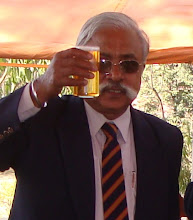
Wednesday, March 11, 2020

REMBERING “THE TIMMY OF INDIA” –
GENERAL KODANDERA SUBAYYA THIMAYYA, PB, DSO


      General Kodandera Subayya Thimayya, also known as ‘Timmy of India’ to his admirers, was a leader of mankind, an architect of History and dispenser of human destiny the world over.  Thimayya was the only Indian to command an Infantry brigade in battle during the Second World War and he is regarded as the most distinguished combat officer the Indian Army has produced. India will long remember him as a soldier who saved Kashmir. He was the Chief of Army Staff of Indian Army from 1957 to 1961.

Anecdotes which bring out certain sterling virtues of the General as revealed from various sources are described in succeeding paragraphs.

Family background and upbringing

Thimayya was born in Medikeri, the district town of Kodagu (Coorg), Karnataka on 31 Mar 1906 to Subayya and Sitamma. His father was a prosperous coffee planter and belonged to the Kodendera clan. Sitamma belonged to Cheppudera clan and both clans among the most respected in Coorg. His mother was highly educated, a social worker and recipient of Kaisar-e-Hind Medal. They were six children – three boys and three girls and Thimayya was second boy. They lived in a sprawling mansion named ‘Sunny Side’. The family was a joint family and the influence of the grandfather the head of the family is said to have been tremendous on Thimayya.

Thimayya’s early education was at St Joseph’s School, Coonoor and Bishop Cottons at Bangalore, before being sent to Prince of Wales Royal Indian Military College (RIMC), Dehradun in 1922, one of the first batches of 32 Indians to join RIMC. While at RIMC Thimayya was selected for pre-commission training at Sandhurst, UK.

RMC Dec 1925
Professional Career

Thimayya had a most chequered and colourful military career and exposures which none of his contemporaries could ever aspire for.

(a)              Thimayya came out with flying colours as 2nd Lieutenant of Royal Indian Army in 1926 and posted to the High Land Infantry- a Scottish Unit. After a year of attachment with Highland Infantry, he joined 4/19 Hyderabad Regiment (Now 4 Kumaon) and served in Iran and North West Frontier Province (NWFP).

(b)             On 19 Mar 1944, Thimayya was appointed as Commanding Officer of 8/9 Hyderabad Regiment in Arakan – the first Indian officer to be privileged to lead a British Regiment in war. His exploits in Maungdaw, Buthidaung and Mangaw against Japanese elicited the highest appreciation from top-echelons of South East Asia Command, including Lord Mount Batten, Gen Stillwell and Field Marshal Slim.

(c)              On 01 Apr 1945, Thimayya was given command of 36 Indian Infantry Brigade in Burma. He was the First Indian officer to lead a brigade in action in Second World War He was awarded the Distinguished Service Order (DSO) for outstanding leadership by HM King George IV- The Emperor of India. As a representative of the Indian Army, Thimayya was present at the formal surrender of Japanese to Supreme Allied Commander, South East Asia at Singapore in 1945.

(d)             In 1946, Thimayya commanded 268 Indian Brigade in Japan and during his stay represented Indian Army at Independence Day Celebrations of Philippines in July 1946 at Manila. After this he did a stint with Armed Forces Nationalisation Committee at New Delhi. Again in 1947 he assumed the command of 5 Infantry Brigade. He was a member of Armed Forces Reconstruction Committee and joined Punjab Boundary Force at the time of partition.


(e)             In the wake of partition in May 1948, Thimayya took command of 19 Indian Division from Maj Gen TW Rees. Thimayya took timely and appropriate action to restore law and order in East Punjab to ensure safe and dignified movement of millions of refugees. As GOC of 19 Infantry Division in Jammu and Kashmir, Thimayya became a legend in Military History. Here he created an unique record in the annals of military strategy / tactics by deploying Stuart tanks over the snow bound 12000 feet high Zozila Pass and broke through strongly held Pakistani positions in the winter of 1948. The enemy was thrown out and Indian troops reached Kargil. He, as the GOC, displayed personal bravery by flying in to Ley in a dakota on 24 May 1948 to evacuate plane loads of the wounded and refugees. Thimayya combined tactical flexibility, firmness of command and the 1948 operations proved him to be a bold field commander, who could outwit the enemy. He was proclaimed to have liberated most of occupied Kashmir – only if an ill-timed ceasefire had not been agreed to.

(f)               1950-51 Thimayya commanded Indian Military Academy,which was forged out of best values and traditions of Sandhurst (UK) and West Point (USA). IMA could not have bargained for more inspiring model than Thimayya to emulate.

(g)              He was appointed as Quarter Master General at Army Headquarters during which tenure, he streamlined the working of the Canteen Stores Department (CSD) India- doing away with contract system.

(h)             On 15 Jan 1953, Thimayya took over charge as General Officer Commanding in Chief (GOC-in-C ) Western Command with the overall command of troops in Punjab, Rajasthan and J&K.

(i)                In Sep 1953, Gen Thimayya was assigned as Chairman of the Neutral Nations Repatriation Commission (NNRC) in Korea. The Commission was made up of delegates from Switzerland, Sweden, Poland, Czechoslovakia and India. He gained international fame at Korea winning many friends and admirers, by his impartiality, justice, and fairplay , sense of humour, curtsey and charm. For his deft handling of this complex and sensitive assignment, he was awarded Padma bhushan. He was even acclaimed 'Mc Arthur of India'.

(j)                On 08 May 1957, Thimayya was promoted to rank of full General and took over as Chief of Army Staff, the post which he held with dignity and honour till 07 May 1961, when he retired.

(k)              Recalling 08 May 1957, when Thimayya took over as COAS, he stated “It was the climax of my thirty one years of service and of course a proud moment for me. I remembered the other moment in Burma, when I had taken command of the Battalion. This moment was similar, but the burden seemed lighter than before. I think this was simply because I now had many more men to help me carry it”.

Courage of conviction

As Chief of Army Staff he proved to be a class by himself – a cut above the rest. He addressed himself to operational preparedness which was uppermost in his mind and not ‘digging wells in Rayalaseema’ as suggested by politicians as an occupation for the Army in peace time. Administrative improvements and welfare of officers, men, defence civilians and their families were closest to his heart. He was every time called ‘soldiers’ General’. Gen Thimayya was not for power or personal aggrandizements, but stood firmly by his values – whether he was dealing / deliberating with Pandit Nehru and VK Krishna Menon. He was a self made ‘tower of strength’ reinforced by what others saw in him – a beacon of the future of India.

Gen Thimayya kept on pointing out to the Government the frightful imbalance that existed between political theory and power equation. The Government’s failure to respond to his strategic assessment eventually led to devastating humiliation later in 1962. 


Courage in face of danger

Ø    Thimayya took over command of an Infantry Battalion while in operations in Burma. Japanese were strongly dug into the tunnels in Buthidaung and were in absolute control of the spine of Mayu Ranges all the way to the North. Thus between 25 and 26 Divisions , Japs could move up secretly along the ridges and attack at any point that they chose, thus cutting of the Line of Communication of the Allies from Chittagong. Japs could also watch every move of the Allied troops from atop the Mayu Ranges. Thus these Japanese positions earned tactical importance, which had to be eliminated. Many attacks failed and ultimately the task of reducing the Jap positions fell on Thimayya and his Battalion. Gen Thimayya decided to put in an unorthodox last light attack against the accepted norms of first light. The ‘Kumaonis’ under the personal leadership of Thimayya crept up the slopes through thick jungles during day light and caught the japs napping in the former’s last-light attack. The mission was a complete success. Gen Thimayya later reminisced of the action “If I failed I was sure to be court-martialed. Even if I took the hill but with heavy causalities, I would be finished.’ Gen Davies the GOC after congratulating Gen Thimayya stated “You are one of the lucky ones”.

Ø    Along with Sheikh Abdullah and the PRO (Col CL Proudfoot), Gen Thimayya was on a visit to an Infantry Brigade at Uri, which had been the first Brigade to operate in the Valley from 1947. The road to Uri runs eastwards along the escarpments of a range of hills with River Jhellum running alongside in a deep gorge down below. En route an officer was waiting to inform the General’s party that an enemy MMG was ranging the road ahead and suggested that they halt at Mahura Power House for ‘All Clear’. General and Sheikh had few words and he turned to other occupants of his jeep and said ‘Hang-on’, and let in the clutch. The MMG had not yet zeroed in on the road and they raced through the arching stream of tracers with a thrill.

Ø    Gen Thimayya’s youngest brother Somayya (Freddie) was second-in-command of a battalion in Uri. He died in a mine blast one early morning and the news was passed to the General immediately. The General took it coolly and told the Brigade Commander not to make a fuss of it, but to cremate as any soldier killed in battlefield and the normal work including patrolling would go on. He did not even inform his old father at Medikeri, as he wanted the news to reach his father in the normal manner through Adjutant General’s Branch, Army Headquarters.

Sporting Character

General Thimayya had a formidable sense of humour. He considered it necessary like luck for soldier to survive and prosper. His sense of humour was to not only provide relief under tension but had an intellectual structure and emotional dynamism. He was essentially a sportive and humanist character. As the ceasefire came in to force between India and Pakistan on 01 Jan 1949, he met and embraced the Principal adversary in Flag Meeting. When amazement was expressed by the United Nation’s Observer present there, he said “we are enemies during war, but we are old friends too”!!!

Compassion

       Magnanimity was a great quality of General Thimayya. He regarded it an essential quality for higher command. He understood the fallibility of man. He would often quote Dr Johnson’s “A fallible being will fall somewhere.!!”, and forgave people.

Incidents of Unusual Interest

Ø    General Thimayya liked nicer things of life and was often seen enjoying himself in Five Star Hotels and restaurants in the metropolis of Delhi. One morning the Prime Minister Mr. Jawahar Lal Nehru sent for General Thimayya in his office and obviously tutored by his intelligence staff, suggested that he should not be seen at public places late at night, as it created a bad impression. To this General humorously replied “Panditji isn’t that better than planning a coup in the middle of the night?”. (Lt Gen Harbaksh Singh, PVSM, Vrc)

Ø    Lt Gen Harbaksh Singh writes’ “Panditji as everyone knows , was at one time very fond of Gen Thimayya. General was immensely loyal to Panditji as a person and would have given his right arm for him. So, when the General submitted his resignation over a difference of opinion with the Defence Minister and later withdrew it on Panditji’s intercession, it was on the part of General a gesture of great deference and regard for the Prime Minister. No wonder that the subsequent castigation of General Thimayya by Panditji on the floor of the House came as a great shock to the General and he terribly felt let down. And those who had to work with him closely noticed a sea change in his attitude towards life. To those of us who had the welfare of the General and the country at heart, this internecine squabble at the highest level of national polity seemed to represent a denial to the country of the valuable services of a rare personality which is born only once in an age.”

Ø    General Thimayya was against senior ranks to club together at the exclusion of juniors. Lt Col Grant, Commandant of CMP Centre & School recalls an incident in a party hosted in honour of the General in his mess when he was a young officer. “On a request from the Second-in-Command of the Battalion to pass a message to his wife, my wife joined the Generals group and finding an empty chair next to the Second-in-Command’s wife parked herself on it so that she could discreetly pass the message to Mrs Second in Command. Awaiting for an opportune moment to withdraw unnoticed, my wife was suddenly taken aback, when Mrs Second in Command told her to leave the group as it was meant only for senior officers. Apparently this little side talk did not go unnoticed by General and his wife and there was some whispering between them. When dinner was announced, the General singled out my wife who had left the group by then and requested the honour of escorting her to dinner, while offering his arm, the General remarked loud enough for all to hear, “Young lady, in the mess we all share the same meal irrespective of rank- obviously a rejoinder to what he had noticed earlier transpiring between senior and junior wives. “

Ø    During Second World War, Thimayya was commanding the Brigade which was first to enter Rangoon. The men were amazed to find that the city was held by Indians of the INA. In the enemy retreat, the Japanese were abandoning the INA. After Japs left Rangoon, the local Chinese population began looting. The INA men stepped in to restore order. But they were anxious to turnover authority to the Allies. By twist of fate, Thimayya’s eldest brother Colonel Ponnappa (Ponnu) was the AQ (Asst Quartermaster General) to the INA (Indian National Army) Forces in Rangoon, and was captured by Thimaya’s Brigade. His brother demanded of the British officer who arrested him that he be taken to Brig Thimayya. The Englishman told him that, “Thimayya was not there”, and added ,”even if your brother were here, he would have you thrown in to the clink straightaway”.  “You are wrong’, Thimayya’s brother replied. “He would give me a cold beer, a hot curry, and then he would have me thrown in to the clink “. “My brother knew me alright”, Timmy said ”That’s precisely what I would have done”.

Ø    In 1935 Thimayya got married to Nina Cariappa , who had returned to India after her education in France. In May 1935 Thimayya was attending Staff College at Quetta (present-day Pakistan) which suffered a devastating earthquake and Nina helped in comforting the homeless refugees of the earthquake. She was awarded the KAISER-I-HIND medal for her social work at the tender age of nineteen, the youngest to do so. 

The Family

  •           Thimayya and Nina had one child – a daughter - Mireille and they led an enviable and emulative family life. Timmy was an ideal husband and a wonderful father and they were a close-knit family. Though Timmy has had extensive western exposures he was not enslaved to western culture and values. And this virtue reflected in bringing up of his family. Though he served in the British Army and rose in ranks and status, Timmy was essentially a ‘son of the soil’ and more Indian and a nationalist than any Indian could be. The impression of Timmy as a father, an officer and a Gentleman has been  amply brought out by his daughter Mireille Chengappa in her frank depositions with Coorg Times, an English Daily. The feature which appeared on 30 Mar 2017, authored by APA Ganapathy, on the occasion of the 111th birth Anniversary of Timmy brings out various sterling character qualities of the General  ( The link is given as a Post Script to this narration.)


Post Retirement Career

Ø    It was Timmy’s outstanding qualities of leadership, maturity, justice and understanding of global affairs that attracted the attention of the Secretary General United Nations (UNO), who offered him the post of ‘Commander of United Nations Forces in Cyprus’ (UNFICYP) in July 1964. Cyprus at that point in time had been torn by the bitter conflict between the Greeks and Turkish Cypriots, which could easily have spun off into another crusade. With six thousand multi-national UN forces under his command, Gen. Thimayya tactfully handled the delicate situation that was ridden with ideological differences as well as bad faith and mutual distrust. His courageous diplomacy became an example for forces all over the world, and provoked the Turkish Foreign Minister to describe Gen. Thimayya’s role as “A superhuman effort to keep peace going”. The Greeks adored his grit, pragmatism and sense of justice as well as his intellect. In this capacity he endeared himself to the rival camps who developed implicit trust in his fairness and judgment.

Ø    . Unfortunately on Dec 18 1965, General Thimayya succumbed to a heart attack at the age of 59. Cyprus cried and the world mourned the loss of an eminent leader of mankind departed before a mission completed.

Ø    The Government of Cyprus in his honour named the main road through Larnaca - Cyprus (East to West) as Gen Thimayya Road. In India , the street perpendicular to East Street (a road parallel to MG road in Pune) and Richmond Road in Bangalore, were also renamed as Gen Thimayya Road in his memory.

Ø    The Republic of Cyprus, also honored him by issuing a commemorative stamp in his memory in 1966.


Commemorative issue Stamp
General Kodandera Subayya Thimayya was born in Madikeri, the district town of Kodagu (also known as Coorg), Karnataka, India. He was a graduate of the Royal Indian Military College in Dehra Dun. He served in the Indian Army from many posts. He became Chief of Army Staff of the Indian Army in 1957. He was also awarded the Distinguised Service Order. After the Korean War, he headed an United Nations unit dealing with the repatriation of prisoners of war. After his retirement from the Indian Army, he was appointed as the Commander of UN Forces in Cyprus (UNFICYP) in July 1964. While in Cyprus, he died of a heart attack, in 1965. The Republic of Cyprus, in addition to this stamp issue, honored him by renaming an avenue of the city of Larnaca after him.

Ø     The General K.S. Thimayya Memorial Trust, a Trust instituted by some Old Boys of Bishop Cotton Boys' School, annually hold the General K S Thimayya Memorial Lecture Series in his memory. 

Ø    Thirty-two years after his death, on December 18, 1997 the body of Gen. Thimayya was exhumed from his grave in Wilson Garden Bangalore and shifted to Army Services Corps (ASC) Centre, Bangalore where he was reburied with full military honours.

Ø    On 31 Mar 2018, in Madikeri, the renovated ‘Sunny Side,’ the residence of General Thimayya was dedicated to the nation on the occasion of his 112th birth anniversary. The Memorial features an exhibition of General’s achievements and a war Museum that has Tanks, replicas and photos of fighter jets  and other war collections. It also boasts of a park and an Amar Jawan War Memorial.

Ø    General Thimayya enjoys an unmatched legacy in the Indian Army.

Tributes to General
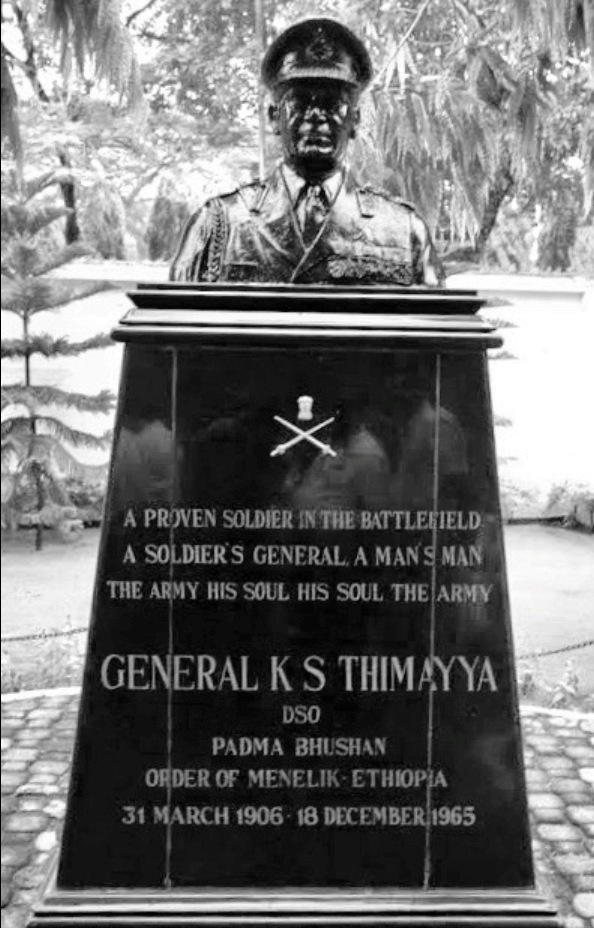
v    Prof VK Gokak Vice Chancellor of Bangalore University and winner of Gyana Peetha Award wrote about Gen Thimayya- “He rose to be the hero of a Nation new born- he served mankind – as a true Indian, upholding peace and helping the forlorn. Bless the soil that gave his birth”.

v    Times of India, Bangalore 19 Dec 1965 writes- “The death of Thimayya has shocked Mysore State, where he grew up as a young boy and later returned to live in retirement. Coorg district from where he hailed is in mourning. ‘Hutri’ Celebrations , a popular festival has been cancelled as a mark of respect to the former Army Chief.”

v    Indian Express New Delhi, 20 Dec 1965- quoting ex COAS Gen JN Choudhry on  Gen Thimayya – “A fine soldier, a gay companion and a man who loved his country”, writes “ In the first early formative years of our independence, the efforts of our soldiers have mattered as much, if not more than the effort of our politicians. ‘Timmy’ like all the good soldiers had no politics in his mind, though it saddens one to think that his brilliant career was cut somewhat abruptly by a confrontation with politicians. India will long remember him as a soldier who saved Kashmir. He lived as he fought and died with chivalry and gallantry. May the sea, earth and sky rest gently on him.”  


v    Field Marshal SHFJ Manekshaw, MC, was asked who, in his opinion, had been the best General of the Indian Army. “Timmy, of course,” he replied and expanded his remark further, “General Thimayya was not only a brilliant tactician and strategist but one whose vision went beyond everyone else’s. The challenges he faced and his response to them were simply incomparable.”

v    Of all the eulogies for him, the late Lieutenant General Premindra Singh Bhagat, VC, PVSM, ADC (Retd.) summed it up best, "A General Thimayya is not born in every generation. It was fortunate for us who still serve, to be of the generation and the Nation of Gen Thimayya. The likes of him there will seldom be, Soldier General, a man's man; the Army was his soul; his soul the Army.”

The likes of General Thimayya are epoch makers, men of destiny,Who leave their footprints on the sands of time- For others to follow.  
                                                 
                        -Col Ravi Nair -  

PS:- Certain articles which throw light on the Character qualities of the General 
1. A Book Review by R Prasannan titled 'Humiliation of a General'  in The Week Magazine dated 24th Jan 2016 on the Book -'1962 War That Wasn't' authored by Shiv Kunal Verma-

 https://www.theweek.in/theweek/leisure/the-war-that-wasnt-by-shiv-kunal-verma-gives-a-total-picture-of-the-1962-war.html     

2.  An article by Abhishek Bannerjee in Op India dated 15 January 2018, which high lights the exemplary virtues of courage of conviction by upholding his commander's actions to safe guard the honour of woman.-

https://www.opindia.com/2018/01/on-army-day-how-general-thimayya-stood-up-to-nehrus-chief-minister-for-the-honour-of-a-woman/        

3.   A feature in Coorg Times ' A Daughter's Tribute to Gen KS Thimayya' on His Birth Anniversary' dated 30 Mar 2017. 

- http://www.coorgnews.in/featuresnewsmakers/daughters-tribute-gen-k-s-thimayyas-birth-anniversary/                                 


( Curtsey to ‘'Thimayya of India: A Soldier’s Life’ by Humphrey Evans, The Star of Mysore, The Coorg Times, Brig MM Ashok Cariappa (Retd), Col KC Subbayya VSM (Retd), President,' Fd Marshal Cariappa Gen Thimayya Forum', Kodugu, , the Google and other relevant publications  )

Saturday, February 15, 2020


A Passage to SPR -(Selected Place of Residence)


        I read an interesting narrative of one of my friends Ravi Nair, my name sake, about the good old times of his father, a VCO (Viceroy’s Commission Officer) coming on leave from Kashmir borders of NWFA (North West Frontier Agency) - where the latter was posted. It read like an expedition to selected place of residence (Home Town- in military parlance) South of Vindhya Ranges!
      
 Reading this, I too was reminded of my travails home from the North Eastern borders, more than half a century ago. I venture to jot down my memories for the posterity. I vividly remember coming on my first Annual leave from Mizo Hills, Vaphai Post, bordering Burma (today’s Myanmar) along Tio River.     

  Tiring tactical move on foot, for four days, through the insurgent prone and leach infested thick jungles, to reach the road head at Tuirial- Aizawl, that too at the convenience of Link Patrols, which ensured the protection to the foot columns.
 

 Then to Laylapur Rear via Wrangte, , in a Convoy of minimum 70-80 vehicles, with a vanguard and rear guard of Armoured Cars. Crouched in the body of a Sakthiman or a Tata Mercedes Benz 3 Ton truck, winding down, forcing one to throw up till nothing is left in ones aching bowels. 

 One night stay at Laylapur - the Rear Echelon of the Unit, to rest and recuperate and to deposit personal Arms ( SMC - Sten Machine Carbine) and ammunition. There, One’s  left behind heavy steel trunk (box) originaly packed with civil clothes and other non-essentials was now subjected to a ruthless process of military re-prioritisation. Clothes were bundled out to make room for the truly essential items - crates of liquor and other CSD (Canteen Stores Department) purchases procured from the Rear Echlon CSD Canteens, for journey home. 

Afterall one had to travel light. The meagre clothes accommodated, merely served as padding to prevent the bottles from breaking - and a soldier had to safeguard the Nation's most fragile assets !  

Next day move to Silchar via Masimpur to catch a meter gauge locomotive steaming out towards Halflong. From Halflong to Gauhati on a broad gauge rail chugging sedate in no hurry , and to be disgorged at Gauhati in the dead of the night. From Gauhati to New Bongaigaon was a nerve wracking traction on a meter gauge .

Whenever the train wheezed into a major station, it was quite a spectacle to see the Army officers among the passengers suddenly come alive. Out they would emerge onto the platform, resplendent in their silken dressing gowns and pyjamas, taking a leisurely stroll along the full length of the train, king-size filter cigarette dangling casually from their lips. Some surveyed the milling crowd with studied nonchalance, while others seemed quite content to be surveyed themselves!😏

One must confess that one felt a tinge of regret that he too possessed the Academy days dressing gown - an essential item in the travelling officer’s wardrobe. Sadly, his had been condemned to a far more utilitarian role, being irretrievably wrapped around his precious cargo (bottles) inside the steel trunk, serving as their protective padding.

Thus deprived of one's rightful place in the platform parade, he gave the whole business a polite go-by. There was little point in regretting lost opportunities for sartorial display when there were still miles to go - and, more importantly, an ETA (expected Time of Arrival) at the next destination to worry about!

After all, in military travel, reaching the destination was the mission; looking impressive on the platform was merely an optional extra.
At New Bongaigaon, walk across the sand banks to the waterlines of Ganges, with the coolie following lugging one's steel trunk on latter’s head. By the way, the trunk had more of bottles than of any clothes, the latter acting only as padding between bottles so as not to break. One felt pity for the coolie balancing the trunk on his head cursing .Walk towards the River ends where the  Paddle Steamer operated by North Eastern Railway waited to ferry one across the Ganges at Farakka.
           Few hours in the steamer, listening to the lapping and splashing noise of its giant paddles in the water and intermittent booming of whistles, brought images of the huge paddle boats of Amazon. Being a First Class passenger the steamer provided steaming rice with watery daal and pickles & pappad as dinner, then in utter contrast coffee served with decoction, cream and sugar in separate ceramic pots (chinked and grimy) -in true occidental style. !

            On reaching the other bank long walk on river sand towards New Jalpai Guri railway station, where the rail rake awaited with similar seat/ berth reservation arrangements. The steam engine laboured the rake to Sealda Station and from there to Howra in a local train .
            Depositing luggage in the clock room. A quick shower and shampoo at First Class Waiting Room and ‘non-itinerary visits’ to Calcutta City just to have a feel of the metro life, and returning for the night train Coromandel Express to Madras. After two nights reaching Madras early morning.

            Once again the luggage to clock room. Taxi ride to relatives unannounced and to the 24 x 7 movie halls Diamond, Emerald and Sapphire, all housed in same building on Mount Road . Normally went off to sleep in the AC comfort of movie hall while intermittently watching of 'Taras Bulba', which had no END, kept repeating. Move to the Madras Central by evening to catch the night's Cochin Express 
.   
             The ‘Canadian Bullet Engine’ took on the initial traction and then local snub nosed ones which sneezed burning coal and dust through out, brought one finally to Cochin Harbour Terminus by noon. ‘Runglee Rungliot’ meaning ‘thus far and no further’.  That was the termination of journey on rails and thence forth in a ‘yellow and black’ Hindustan taxi for move to Alleppey 65 kms away.

            And, Alas by evening, after a fortnight of having set forth from Vaphai, one entered his ‘selected place of residence’ and to ones Sweet Home, waking up and surprising his mother and siblings - as the FL (Forces Letter) -FOAS (Free on Active Service) one had posted a month early from ones picquet of announcing sanctioning of his leave and tentative travel plan, had not reached his mother, after customary censoring at 99 APO, till then. Hence, surprised indeed - they were.
           The matted hair filled with few pounds of coal dust, grime and the telltale ‘railway acquired syndromes’ for over a week, like bugs and lice, had to be scrubbed off. Answer mother knew, bar soap (used for washing clothes) and ‘besan flour’ with abrasive ‘incha scrub’, ‘Amma’s special concoction of coconut oil massaged lavishly and washed down with scores of buckets of water from the well, drawn and ‘water cannoned’ by family’s ‘man Friday -‘ Bhaskara Pillai, who showed signs of kindness on promise of two pegs in the evening !😖

           By now the meagre amount of Rs.200/- discounted through a bank cheque from unit Baniya (Wet Canteen Contractor), for the journey had dried out. First thing in the morning was to visit ones bankers to whom all the salary - a princely sum of Rs. 345/- was remitted after the TDS of Rs.5/- every month, irrespective of where one was posted. It was a big money indeed, as a Sovereign (Kuthira Pavan of 8 gms of 22 k gold) costed only Rs.90/-.! Also was surprised to find nearly 2k in the bank to blow up! Serving in field, the entire salary got accumulated in the bank as there were no scopes to spend on a picquet, where ‘roti, kapada, makkan’ were free.!

          With ‘kuppies’ (bottles) full in crates, crisp notes in the pocket, and cartons of 555 and Kent in lieu of few pegs to right friends with US connections! ; And ones First Love - the original British Royal Enfield KLT 7724, gas always fully filled - life was worth living !😁


        Once the 'Kuppies' receded in the crates, the 'Panam' (currencies) began disappearing in the pocket and the 555s and Kents extinct and replaced by Panamas and Charminars, friends who had earlier welcomed one's visit gradually developed a psychological curiosity, "When are you returning?" - That was the beginning of the end !  😒 

         Eventually one had to approach the ultimate financial institution - Amma (Mother). So one returns to the Amma for a ‘non- refundable loan’ for financing her son's ‘expedition back’. Totally demoralised and ‘home sick’ - But one ought to return! call of duty !, One would overcome this annual setback, retracing the trail . Time is a great healer . 

        The present generation soldier cannot imagine such a situation. Airforce Courier service, concessional air travels, authorised LTCs by Air, fast electric trains and the Farakka barrage over Ganges, beautiful roads wider than NHs crisscrossing and ‘spiralling’ the Mizo Hills heights - where we once heaved and perambulated, and above all the mobile phones which announced and videoed live minute to minute progress of one’s move etc - were nonexistent and couldn’t even be thought of. 
-To achieve surprise nowadays is difficult!!!
       
         In those days , a soldier could disappear in the wilderness for months and then suddenly materialise at his mother's door steps. And perhaps that was one of the great charms of those times . 
        
        The home-bound journey itself became an adventure - an unusual stirring experience ! And after fourteen days of marching on foot , bouncing, sneezing, sleeping, scrubbing, spending and borrowing - we finally reached Home.

        And for a brief and glorious while - Life was worth Living !🙏                           
   - Ravi Nair- (Sikh LI)


Thursday, February 13, 2020


Encounter with an Ani  
🪖🤔 PONDERINGS OF A PONGO 🤔🪖 

A saving Grace from heaven.

self with a Khampa tribal with Ani Gumpha in the back drop

In the evening of life, when one looks back upon the long trail already traversed, countless episodes and anecdotes come flooding back. Some leave a lasting imprint; others fade into the mists of time. Yet there are a few that remain remarkably vivid, even after more than half a century. One such episode, which continues to haunt my memory with extraordinary clarity, was my encounter with an Ani - a fully ordained Buddhist monastic, or Bhikshuni - at Ani Gumpha, a female Buddhist monastery in the remote frontier district of Tawang in NEFA (North-East Frontier Agency). The memory has been bubbling and frothing in my mind for some time, and I feel compelled to pen it down before the finer details recede into the shadows of recollection.

While the rest of the Battalion enjoyed a measure of relative cohesiveness at Rupa in the Tenga Valley, I, a young Lieutenant, had been posted to Bum La on the McMahon Line, a place two to three days away. In those days, distances in the mountains were measured not in kilometres but in the time taken to traverse them. In retrospect, dumped and forgotten might have been a more appropriate description than posted! 

My task was to hold the border post, situated at an altitude of approximately 17,000 feet, along with an Observation Post another 2,000 feet higher, manned round the clock. My effective strength was a modest 15–20 mundas - my men.

Mundas bringing potable water

Apart from routine patrols to nearby areas and occasional visits to Sector Headquarters at Pankang Tso, a six-hour trek away, life at Bum La was placid, if somewhat sterile. The place remained snowbound throughout the year, with winter snowfall often exceeding six feet on the snow ruler. Neither mules nor Haflingers - the sure-footed Austrian hybrid pack horses - ventured beyond Mi La Pass because of the steep gradients and the ever-present danger of losing these precious animals. The Animal Transport (AT) supply chain terminated at Mi La. Beyond that point, the four-hour, steep ascent to Bum La became an ordeal of man-packing and piggybacking. Only the bare essentials for survival could be carried forward; luxuries were a distant dream.

On clear, sunny days, the entire landscape, stretching as far as the eye could see, glittered like a magnificent silver platter. Even the watershed marking the McMahon Line and the terrain beyond it shimmered beneath the sun. The fierce ultraviolet rays, reflected and refracted by the snow, could burn one's exposed skin to an almost ebony finish. Without snow goggles, one risked snow blindness. 

 Moonlit nights were positively sepulchral, often playing tricks on the imagination and inducing strange hallucinations. Above us, the sky was a celestial kaleidoscope of falling stars and meteors. The rarefied atmosphere rendered the heavenly bodies extraordinarily clear, sometimes displaying prismatic colours that lent the entire scene an almost surreal aura.

        View from Bum La - Watershed on Mc Mahon Line

Life demanded constant vigilance against the cold. Even while struggling to snatch a few elusive hours of sleep, one had to remain clad in five layers of Extra Cold Clothing (ECC), the body's protection depending more upon these layers than upon the accommodation available. 

Regulations prohibited permanent or semi-permanent structures, leaving us to make do with makeshift sangarhs, fashioned from layers of stones, wild moss, CGI sheets and PBS rolls. These pitiable contraptions could barely withstand even a minor blizzard, which was a frequent visitor, particularly at night. Our makeshift canopies would often be blown away, allowing snow and sleet to pour in and making sleep impossible. Many a night, we found ourselves praying for first light and for the fury of the blizzard to relent.

Being the only officer at the post, and a greenhorn Thampi (a Madrasi, as I was affectionately identified) among my Sikh Khalsas, I remember experiencing moments of formidable loneliness. 

My only links with the outside world were a Philips transistor radio, tuned to Radio Ceylon and the BBC, and the twice-daily “Sab Achha”—all well—reports to the Sector Commander over the field telephone. Ironically, those calls often became an additional source of misery. On cloudy days, the telephone could deliver a nasty electric shock, while the conversation invariably seemed more likely to bring additional tasking than relief from the monotony of isolation.

I soon realised that the only antidote to this creeping morbidity was to keep moving. Accordingly, I volunteered for a six-day Long Range Reconnaissance Patrol (LRP) to Kharsan La, a journey involving a three-day trudge through deep, untamed snow and ice. We preferred to be out in the open, sweating and struggling, rather than languishing in forlorn isolation. The Sector Commander was delighted that the request had come from me.

After the briefing, a thorough check of all logistical and operational arrangements, and the solemn Ardas seeking the blessings of Waheguru at our little Gurudwara Sahib, the patrol was ready to move. It consisted of one officer—yours truly—and seven men.

 
Tibetan Bhutia

 Our mascots, two enormous Bhutia dogs, growled impatiently, straining at their leads as though determined to lead the expedition themselves. In the wee hours of the morning, we stepped off in high spirits, hoping to cover as much ground as possible on the first day. The weather was clear, and there was no fresh snowfall. We were venturing into virgin territory, as this was our maiden patrol to Kharsan La. 

Whenever allowed to roam freely, the dogs took the lead. They seemed instinctively adept at avoiding treacherous patches of soft snow and gave us early warning of wildlife in the vicinity - musk deer, snow leopards, wild pheasants, other wild dogs and, above all, unfamiliar human presence.

Rhododendron bush

I was leading the patrol, negotiating knee-deep snow, and at certain places we had to crawl on all fours to distribute our body weight. While crossing a snow-covered mound, the surface suddenly gave way beneath me. I plunged into a deep pocket of soft snow concealing the stiff, woody branches of rhododendron bushes, the only vegetation that seemed capable of surviving in those conditions. I crashed through the unforgiving branches, sustaining bruises as I fell, until, fortunately, my descent was arrested by a rocky ledge some twenty feet below.

 I could hear our dogs barking furiously and digging at the spot where I had disappeared. My senior NCO, Havildar Bhajan Singh, was the first to reach the edge. It took the patrol nearly an hour to cut a passage down to me and haul me back to safety. 

Fortunately, the bruises were not as serious as I had feared, and some elementary field dressing was sufficient. Before long, my men were cheerfully brewing tea and regaling me with their inimitable bawdy jokes. I was the first to be offered a steaming glass. “Saheb Bahadur ji, gut-gut chai pee lo. Sehat theek ho jaogi!” - (Sahib, have a few gulps of hot tea; your health will soon be restored) . Such was the affectionate irreverence of my men!

 After that invigorating brew, we resumed our march, carefully avoiding suspicious snow mounds. By evening, we reached a grazier's hut, announcing our arrival to its surroundings through the distant, tell-tale clanking of yak bells. We decided to camp there for the night with the grazier and his animals. 
He was a man of indeterminate age, but warm-hearted and hospitable. I was fascinated to find him painting a Thangka, a traditional Buddhist religious painting depicting the Buddha. Even more intriguing was his method of preparing vegetable dyes by chewing local shrubs. Over a tot of rum - which my buddy invariably carried for me - the grazier agreed to sell me the finished painting after a fortnight in exchange for two bottles of rum, our convenient currency of “dollars” in those remote parts.
 The company of our hospitable host had another advantage: Havildar Bhajan Singh magnanimously exempted me from my turn of sentry duty that night!
Tankha

(I eventually collected the Thangka during a subsequent patrol and presented it to our Officers' Mess. It adorned the walls of the anteroom for years, until, I was later told, it was condemned after suffering a termite attack.)

        The following day dawned clear, and we made good progress, eventually reaching another abandoned grazier's hut. Its slate-tiled roof had collapsed, and snow had filled nearly half the interior, but the walls were still standing. With last light fast approaching, we decided to camp there. Although the missing roof offered no protection from the falling snow, the surviving walls at least shielded us from the full fury of the howling blizzard.

        We set off early the next morning and, by evening, reached an Assam Rifles post at the foothills of Kharsan La. The hospitality we received was memorable. The post commander, a Junior Commissioned Officer (JCO), welcomed us warmly, and I was allotted a proper room in their guesthouse, which even boasted a Western-style toilet! To celebrate our arrival, the men had butchered a precious Meat on Hoof (MoH) - a bakra, or goat - and generously shared the feast with us. After the hardships of the preceding days, this was luxury of the highest order.

        With the morning sun came another leg of our journey. We continued towards our objective, circling a magnificent waterfall whose sprays produced surreal rainbows in the sunlight. The day's march involved climbing, negotiating slippery slopes and sliding over rock-hard ice, but we steadily closed in on our destination. As the last light began to fade, we made camp in a natural depression, seeking protection from the strong winds and their debilitating wind-chill factor.
Pass

We set out again in the early hours the following morning and, by 0900 hours, reached the frozen lake bordering Kharsan La. The lake was covered in ice, and I considered it prudent to cross its frozen surface rather than make a long detour around it. Taking two men with me, I left the remainder of the patrol behind a huge rock for protection. My mundas were eager to brew tea, but I forbade it on security grounds. The smoke could betray our presence and attract unwanted attention. 

We crossed the lake and reached a vantage point near the pass. Careful not to expose ourselves against the skyline, I moved farther down and began observing the terrain ahead through my binoculars. I could make out a track disappearing behind a hillock, with occasional movements of vehicles and pack mules. I completed a panoramic sketch and recorded my observations. My trusty HMT Jawan watch showed 1500 hours. Clouds were gathering on the horizon, and visibility was deteriorating. We abandoned our observation position and hurried back through the pass.

Curiosity, however, proved to be a dangerous companion. At the crest of the pass, I noticed a series of abandoned trenches along the ridge. On closer examination, I found that every one of them faced due south - towards the direction from which we had arrived! It felt as though I was personally inspecting the defensive positions of an adversary. Fortunately, common sense prevailed, and I moved away before curiosity could get the better of me.

 After crossing the frozen lake again, I noticed similar trenches disposed along its banks. An uneasy suspicion began to take hold: we might have strayed well beyond our intended area, perhaps even across the international boundary. I assembled the patrol, explained our predicament and urged everyone to move towards the safety of our own territory without delay.

By then, the clouds had descended upon us, and heavy snowfall had begun. Our maps were of little use. With no visible landmarks or discernible geographical features, map-reading became virtually impossible. Even our own tracks had disappeared beneath the fresh snow. The only option left to extricate ourselves from this shtook was to set a compass bearing due south and keep moving. Visibility was almost nil. We advanced with our arms outstretched, maintaining physical contact with one another. Soon darkness enveloped us, and movement became increasingly hazardous.

We halted and began digging a deep snow shelter to escape the direct fall of snow and the fury of the blizzard - the dreaded yellow wind blowing down from China. We excavated a hollow large enough to accommodate all of us, crouched together with our arms around one another's shoulders, and covered ourselves with ground sheets and kapok mattresses. Our collective body warmth became our only defence against the freezing night. Dinner consisted of our reserve composite ration of shakkarpara. Those who had already consumed their share surreptitiously on previous days had to make do with whatever their comrades were willing to spare. Sleep came fitfully, interrupted by discomfort, cold and anxiety.

The following morning, we emerged from our makeshift igloo into a grey world where visibility remained poor. Soon, my buddy appeared with a glass fashioned from the cut-off bottom of a rum bottle, filled with warm, black and uninviting tea. I asked why it was so bland. Hesitantly, he explained that the milk powder and sugar had run out. So, I thought wryly, life too would remain bland from then on! I asked whether everyone had had tea. “Haan ji!” (Yes Sir!) came the prompt and unanimous reply.

While I sat down to work out our next move, my breakfast arrived: a single chapati, spit-cooked, accompanied by a spoonful of pickle and a glass of warm water smelling suspiciously of smoke and kerosene. The chapati was discoloured, with traces of olive green, and had a distinct taste of blanco. My repeated questioning eventually brought the reluctant truth to light. The flour had run out, and my men had scraped material from a Pack 08 carrying harness to prepare a single chapati for Sahib Bahadur! By then, I had already bitten into half of it; I could not bring myself to eat the remainder. 

I remember my eyes welling up, despite the bitter cold. I asked whether the men had eaten breakfast. Once again came the prompt response: “Haan ji!” - followed by a broad smile stretching across their badly chapped lips. I knew instinctively that it was a lie, but one I could neither punish nor bring myself to challenge. Their loyalty had found expression in a sacrifice that no regulation could prescribe and no order could demand.

We resumed our southerly march, guided by the compass. I checked our radio communications with Sector Headquarters, only to discover that the set could receive but not transmit. From the base at Pankang Tso, I could hear the radio operator repeatedly calling out: “Jankee Phor, Jankee Phor (Yankee Four), report my signals, over! Jankee Phor, nothing heard, report, over!” I instructed our signaller to change the battery. To my utter disbelief, I was informed that the spare battery had been left behind to reduce the carrying load. I controlled my temper and ordered him to switch off the set to conserve the remaining charge. 

With visibility still poor and the blizzard raging, we continued cross-country, guided solely by the compass needle, climbing and descending as the terrain dictated. We even attempted to scale cliffs, only to be forced back to the bottom. The afternoon slipped away, and the fading fluorescence of daylight gave way to darkness. Once again, we dug ourselves into the snow for the night. Hunger and exhaustion soon overwhelmed everyone.

The next morning, I did not even expect tea. I merely asked for some warm water. My buddy hesitated before informing me that the matchbox had become wet and was useless. Since none of the men smoked, there was no alternative source of fire. At first light, we resumed our southerly march. The men were exhausted from lack of sleep and food. Some struggled even to carry their weapons; for others, the carrying harnesses and equipment had become unbearable burdens. The fitter men began carrying the weapons of their weaker comrades. I, too, took turns carrying an additional SLR rifle. Every step was becoming an exercise in endurance, and the patrol was beginning to show the physical and psychological effects of prolonged deprivation.

Soon, we came across a dilapidated, windblown structure that appeared to be the remains of an old prayer hall. As evening approached, I decided to halt and grant the men some respite. Quietly, I acknowledged to myself that I needed the rest as much as anyone. The signaller's repeated attempts to contact the base continued to fail. The staccato crackle of the AN/PRC-25 radio wireless set was punctuated by the increasingly desperate calls from Pankang Tso: “Jankee Phor, Jankee Phor, report, over!” I finally switched off the set to conserve its depleted battery. Sleep mercifully overtook us, while one man at a time remained on guard.

With the first light of the next morning, we reorganised ourselves and moved out once again, faithfully following the magnetic compass towards the south. By now, exhaustion had taken a terrible toll. Tempers were frayed, men were collapsing into the snow and some were reluctant to rise. The weaker ones were being piggybacked by their fitter comrades, and the entire patrol was inching forward like a procession of zombies.

 As the leader, I did not have the luxury of surrendering to exhaustion or even voicing my own distress. I coaxed, cajoled and goaded my men with a colourful repertoire of gaalis - the choicest Punjabi expletives in my vocabulary. Soldierly affection, in such circumstances, sometimes assumes rather unconventional forms!

Despite my rebukes, the men had begun eating snow to alleviate their thirst and hunger. Our two Bhutia mascots, which had been leading the way, were nowhere to be seen. Perhaps the pursuit of a curious snow hare or some other elusive creature had separated them from us. By afternoon, according to my HMT Jawan chronograph, we were utterly spent, close to physical collapse. 

Even the gaalees (abuses) had dried up, our throats too sore to produce them. It was now the third day without proper food, potable water or communication with our base. Panic was beginning to surface, and I knew that, as an Afsar and Sahib Bahadur ji, I could not afford to lose my composure.

We had slumped into yet another enforced halt, the men lying prostrate on the snow while I squatted upon a mound, contemplating what the future might hold. Suddenly, one of the men sprang to his feet, cupped his ears and strained to listen. “Kutte bhaunk rahe hain!” he shouted - The dogs are barking! It was an unmistakable sign of human habitation. Soon, I too could hear the distant growling, barking and snarling of Tibetan mastiffs. 

The men initially surged towards the sound in desperation, but I quickly brought them under control with a few well-chosen expletives. Regaining their composure, they reorganised and advanced cautiously. At that moment, I sorely missed our own Bhutia mascots, whose instincts had served us so well.

From the snow and fog emerged an apparition of a weird human being. Getting closer we realized that it was an old woman in the garb of an astute Buddhist religious order. She was exceptionally tall, an old 'Ani' (bhikshuni) and appeared to us as a Grecian Goddess, led by two ferocious wolves with formidable bared fangs. Her yell, silenced the dogs and she gesticulated towards an ancient isolated structure of a Gumpha (monastery), partially hidden by thick fog and snow and cautioned us not to proceed beyond the entrance gate of the Gumpha, as any man trespassing into Ani Gumpha (Female Buddhist Nunnery) was sacrilege. 
The saying was that they were so astute that, leave aside any men folk, they didn’t even permit male species of animals or birds into the Nunnery. Diametrically opposite to what was the practice at the Jang Gumpha (male monastery) at Tawang. No female species were admitted into that Gumpha. !!!
Tibetan Mastiff -( Curtsey googles)
We all just slumped where we were and requested the venerable 'Ani' for some hot tea, more by gestures, as none of us were in a state to speak!!! Everyone had sore throats due to excessive consumption of snow to quench hunger and the mouth when opened looked like the open beak of fledglings - red and parched!!! Most men had dried lips to the point of bleeding. 
 I could perceive the maternal care in Ani’s slanted eyes. She gestured to us to relax where we were and left, leaving the two ‘wolves’ behind to keep an eye over us. Keeping an eye they did while circling around and sniffing each one of us; their smell was nauseating and in retrospect, may be ours to them too!! 
In a few minutes, she returned with two more 'Anis' carrying begrimed buckets made of some dubious metal, but containing steaming local tea brew with globules of yak butter, rock salt and visible yak hair floating all over. As the leader of the miserable looking gang, I had the privilege of the first mug of this hot brew. What a feeling it was … as if having Amruth !! I reminisce guzzling down nearly three mugs full, and so did my men. 

Miraculously, At that very moment our communication got through to our base at PankangTso . I had no ears for the pure, chaste and select expletives-'galies' MC/BC / @#*-@ etc - from my Sector Commander (Maj xxxxxxx) who by our lack of communication so far must be mostly convinced that we had strayed across the border and by now were en-route to Peking, sans our boots !!! My reply was only that we are at Ani Gumpha, starved for 3 days and need hot food immediately!!! And we are not moving till ‘Khuraak’( food supply) arrives. To avoid taking his protests I chose to then hastily cut off the radio set, and a wise decision it was. 
At Pankan Tso

The response was astonishingly swift. In less than three hours, familiar faces from Pankang Tso emerged through the snow and fog, carrying hot sabjis, dal and rotis. It was a record of sorts, considering that the journey normally took more than four hours even in fair weather. 

This was the kind of camaraderie one seldom encounters outside the armed forces: men who could be fiercely critical of one another, yet would move heaven and earth to rescue a comrade in distress. And the Sector Commander, despite his fury, had not forgotten the finer courtesies of soldiering. He had sent along a bottle of the Army's free-issue Himalaya Ghoda Rum as a little compliment!

We shared our food with the Anis, those heaven-sent angels who had appeared at the precise moment of our greatest need. Before departing, I offered the remaining quarter-bottle of rum to the elderly Ani, suggesting that she keep it for medicinal use in an emergency. She blessed me profusely. Overcome with gratitude and reverence, I bent down and touched her feet before taking leave. In that remote, snowbound corner of the Himalayas, religious conventions had momentarily yielded to something more fundamental: the bond between a fellow human being in distress and the compassionate soul who had come to his aid.

By nightfall on the eighth day after leaving Bum La, we reached Pankang Tso. Reporting to the Sector Commander, I found him still in a thoroughly foul mood. After dismissing the patrol, he summoned me into his Arctic tent. I followed him inside, only for him to turn abruptly and deliver a resounding slap that left my head spinning and stars dancing before my eyes. “You fool!” he roared, punctuating his words with a colourful assortment of expletives. “The Divisional Headquarters has been eating my head over the whereabouts of your patrol! Intelligence reports indicated that the Chinese had laid ambushes along the border to capture Indian patrols. And what am I supposed to make of your radio silence?”

With Jang Gumpha in the background

By then, I had learnt that on such occasions, it was wiser to remain silent rather than attempt to explain or complain. Once his initial fury had subsided, I ventured a lighter explanation concerning the obsolete maps we had been carrying. The border had apparently been marked with extraordinary ingenuity by an Intelligence Section Havildar. Since cartography was considered a highly technical function, the task had been entrusted to the INT - Intelligence -section. Our INT da munda (man from Intelligence Section), however, seemed to have exercised his intelligence rather liberally. I imagined him drawing the boundary line on the map just as a mosquito bit him on the nose! The resulting line, drawn with such authoritative confidence, had sent us wrestling with deep snow and the dreaded yellow blizzard along a boundary that might have existed more convincingly on paper than on the ground. Our eventual extrication to safety was a saga in itself. 

Nevertheless, I was censured for failing to conduct a thorough personal check of the patrol's logistics before departure. It was a lesson learnt the hard way, and one that remained with me throughout my military career.

For all his outward harshness, the Sector Commander was not without compassion for his young subaltern. A teetotaller himself, he had arranged a special dinner in my honour, complete with my preferred brand of Hercules XXX rum and a junglee murgha - wild fowl - speciality. His anger had not diminished his concern for the welfare of his men or his affection for a young officer who had been through an ordeal. It was a characteristic blend of stern discipline and unspoken care that one came to recognise in the old school of military leadership.

As we prepared to retire to our respective tents, the Commander reminded me that I was expected to be back at Bum La, a six-hour climb from Pankang Tso, by 1100 hours the following morning. This meant stepping off at 0500 hours sharp! Yet, in the midst of all his admonitions, he found time for a final piece of fatherly advice: “Ravi, dheere-dheere chalna, lekin time te pahunch jaana”—Ravi, go slowly, but make sure you reach on time!Sic.😕

That night, the venerable Ani appeared in my dreams and blessed me.👐

In the evening of one's life, when one pauses to revisit such extraordinary experiences, one cannot help but feel overwhelmed by gratitude to the Almighty. Through the many trials and tribulations of a soldier's journey, divine grace often reveals itself in unexpected forms - in the loyalty of one's men, the stern but compassionate hand of a commander, the instinct of an animal, or the kindness of a stranger in a remote Himalayan monastery. That day, in the midst of snow, hunger, exhaustion and despair, salvation came in the humble form of an elderly Buddhist nun and her steaming mugs of yak-butter tea.

To this day, I remain convinced that the Ani was no ordinary apparition in the snow. She was a messenger of mercy, appearing at the very moment when hope was ebbing away. Whether one calls it providence, divine intervention or the boundless compassion of the human spirit, I know that we were granted a second chance that day.

Somewhere along that snowbound trail, Heaven had reached out to save us - and I shall remain eternally grateful.🙏


- Col Ravi Nair -